(914) 325-8464


Why Do I Wake Up in the Middle of the Night?
By Dr. Shelby Harris, PsyD, DBSM · Board-Certified in Behavioral Sleep MedicineYou don’t have trouble falling asleep. Falling asleep is the easy part — you’re out within minutes of the light going off. The trouble comes later: 1:40, 2:15, 3:30, a different time every night, like your sleep has a trapdoor built somewhere into the middle of it. Some nights you drop back under in a few minutes. Other nights the floor gives way and you’re up for an hour or more, listening to the house and doing math you never asked to do.
If that’s your pattern, here are the two most useful things I can tell you. First: waking up at night is normal — every night, for everyone. And second: what happens in the few minutes after you wake has more to do with whether you’re up for an hour than whatever woke you in the first place.
Waking at night is normal — staying awake is the problem
Sleep isn’t one continuous state. It runs in cycles of roughly 90 minutes, and between cycles everyone surfaces — briefly, several times a night, at every age. Good sleepers wake too. They just don’t remember it by morning, because the wakings are short and nothing pulls them the rest of the way up.
So the goal was never zero wakings. That’s not how sleep works, and chasing it is a losing game. The thing worth your attention is the version where you keep getting stuck on the surface — awake long enough to be frustrated about it, often enough that your days are paying for it. There’s a name for that pattern — sleep-maintenance insomnia — and it’s one of the most common forms of insomnia I see. It’s also very treatable.
What’s surfacing you
The back half of the night is lighter than the front. As the hours pass, you spend less time in deep sleep and more in lighter stages and dreaming sleep, where you’re much closer to the surface. So from roughly 2 a.m. on, it doesn’t take much to nudge you awake — and the list of things that can do the nudging is long.
Alcohol is the classic. It’s sedating at first, so you drop off fast — then, a few hours in, as your body finishes processing it, the effect reverses and the back half of your night gets lighter and more broken.
Temperature — a room that’s crept too warm, covers that don’t vent, a partner who runs hot.
A full bladder — and the trap that comes with it: the half-asleep bathroom trip that turns into a fully-awake return, because the lights went on and the mind came with them.
The household — a snoring partner, a cat with opinions, a kid at the bedside, the furnace kicking on.
Age — sleep thins as we get older. More brief wakings is partly just how sleep changes over the decades, not a malfunction.

Any of these can surface you. But here’s the thing: they’re often not the whole story. Plenty of people get nudged awake by all of the above and are back asleep before they could tell you it happened. Which brings us to the part that matters most.
What turns a waking into an hour awake
It’s often not the waking — it’s the greeting it gets.
You surface, which is normal. Then you check the clock, which turns a waking into an event. Then the math starts — if I fall asleep right now I can still get five hours — which turns the event into a problem. Then you start working on the problem: lying very still, trying to relax harder, bracing for tomorrow. And sleep is one of the few things in life that retreats the harder you chase it.
Do that enough nights in a row and something quieter happens underneath: your brain starts to expect it. The bed gets re-labeled as a place where you end up awake and frustrated, and the waking starts arriving on schedule, because your system has learned to check. If yours lands at the same time every night, that clockwork version has its own article. And if what takes over when you wake is a mind that won’t stop talking, that has one too.
The point is this: the surfacers wake you, but the pattern — the clock, the math, the effort — is what keeps you up. That’s actually good news, because the pattern is the part you can change.
What doesn’t help
Going to bed earlier to make up for the lost hour. More time in bed with the same amount of sleep in it means more time awake in the dark, and more evidence for your brain that bed is where the lying-awake happens.
The nightcap. It trades a faster drop-off for a broken back half — the exact half you’re already struggling with.
The phone. Scrolling until sleep sneaks back feels harmless, and it hands your brain light and content at the one hour it needs neither.
And lying there “resting” out of principle. If you’re frustrated and wide awake, staying put isn’t rest — it’s rehearsal.
What actually helps
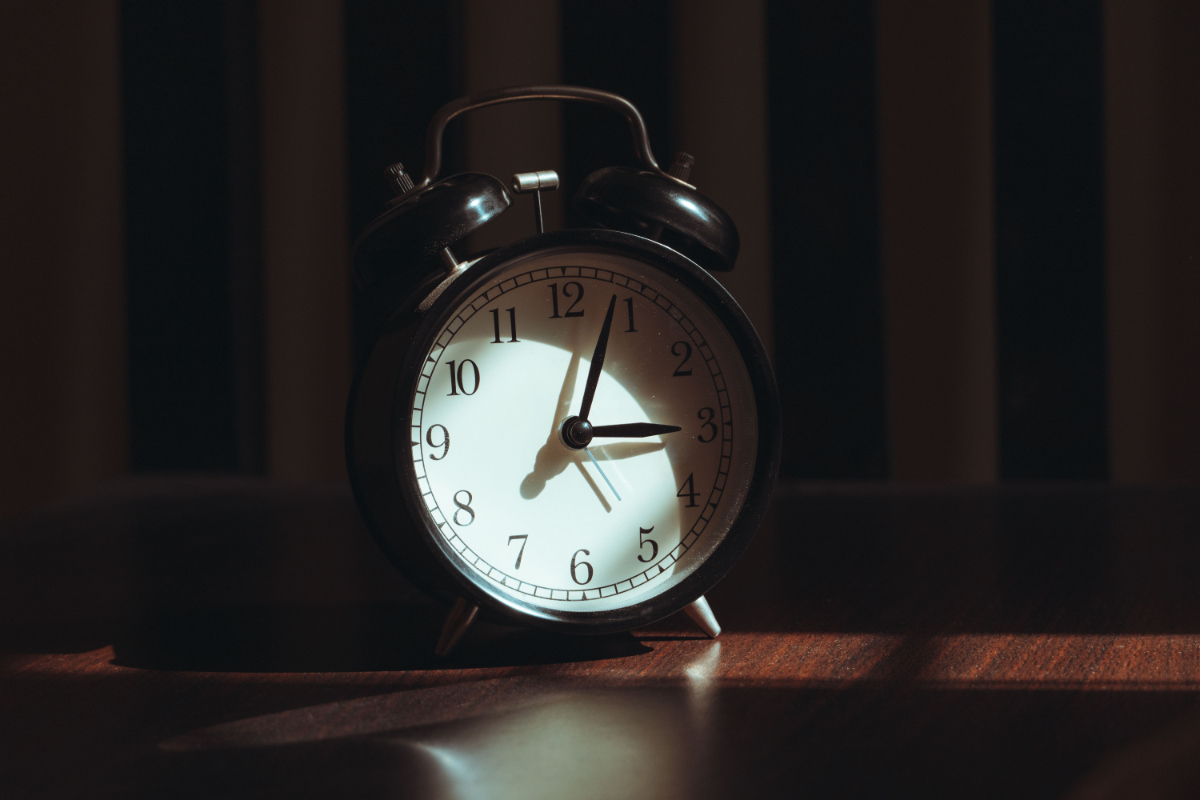
Keep the clock where you can’t see it. The math never helps, and you can’t do math on a number you don’t have.
If you’ve been awake long enough to be clearly, frustratedly awake — for most people that’s somewhere past the 15-or-20-minute mark — get up. Go somewhere else, keep the light dim, do something quiet and genuinely boring, and come back when the sleepiness shows up. It feels backwards. It’s also how the bed gets its old label back.
Make the bathroom trip boring too: light as low as possible, no detours, no phone.
Move the drink earlier — or run a two-week experiment without it and see what the back half of your night does.
And if the pattern has already set in — if the middle of the night has become something you brace for — there’s a structured treatment aimed at exactly this. It’s called CBT-I, it retrains what your brain has learned about your bed and rebuilds the night from the middle out, and both the American College of Physicians and the American Academy of Sleep Medicine recommend it as the first-line treatment for insomnia — before medication, not after. It’s the core of how I work with insomnia patients.
When it’s worth a closer look
A few versions of night waking deserve their own attention, because they’re not insomnia and insomnia treatment won’t fix them.
If you’re waking every hour, all night — or you’re unrefreshed no matter how long you sleep — and especially if you snore loudly, wake gasping, or a partner has noticed pauses in your breathing, raise it with a physician. That pattern points toward a breathing issue, which has its own evaluation and its own treatment path. If what wakes you is your legs — restless, crawly, have-to-move — mention that too. And if you’re waking early with a low mood that follows you through the day, that deserves attention in its own right, not just as a sleep problem.
None of this is cause for alarm. It’s about making sure you’re treating the right thing.
The bottom line
Waking at night isn’t a defect in your sleep — it’s part of the architecture. The problem worth solving is what happens next: the clock, the math, the effort, and a brain that’s been taught to expect trouble in the middle of the night.
All of that is workable. Give the basics an honest two to three weeks — the clock out of sight, the getting up instead of lying there, the drink moved earlier, the dim bathroom trips. If you’re not seeing results, I’d recommend seeing a physician or a behavioral sleep specialist, because at that point the answer is often treatment, not more effort.
You’re not broken-slept. You’re most likely just stuck in the after — and the after is exactly what treatment changes.